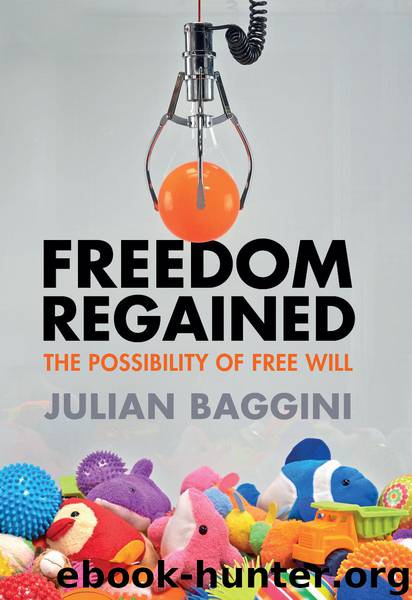
Freedom Regained: The Possibility of Free Will by Julian Baggini
Author:Julian Baggini [Baggini, Julian]
Language: eng
Format: epub
ISBN: 9781847087164
Publisher: Granta Publications
Published: 2015-04-01T19:00:00+00:00
Brains and genes have been largely absent from our discussion of artists and dissidents as paradigms of free will. Once you focus on what meaningful free will comprises, such things become irrelevant. When we understand how artistic and political freedoms work, we see clearly that there is no need to think of choices as undetermined by prior events or independent of brain activity. Nor do we have to think of free agents as ultimately responsible for being the people they are. When we think about how artists and dissidents operate, none of the histrionic cries from those who deny free will have any force. The fact that the brain in some sense produces ideas, beliefs, desires and actions is besides the point, because no one is claiming that they come from some free-floating self. In the case of both the artist and the dissident, it is apparent how much of who we are and what we do is given. Freedom cannot be the ability to build a life and to make choices from scratch.
To be free is for one’s decisions, actions, beliefs and values to be one’s own. We are more free to the extent that we are more self-directed, running along our own tracks rather than on those laid down by others. For this to be the case there needs to be a significant contribution from conscious thought at some stage in the process. But that does not mean every action, every thought, must be the product of a deliberation. All of this should be clear in general terms, and more of the detail will be worked out shortly when we see how freedom is diminished.
We have also seen that since freedom is not absolute, it is a matter of degree. Our mistake is often to think of ‘the will’ as a capacity that we exercise or not, and is therefore absent or present. It is better to think of freedom as something we have more or less of. And this explains why there is never a knock-down discovery that proves we do not have free will. Going back to the science, we discover that in every case where free will is denied, what is shown is merely that we have less control in many circumstances than we think we do. And it is precisely because such judgements are always comparative that we can understand the difference between pathological and normal cases: again something we will be looking at in more detail shortly.
Not only is freedom a matter of degree, it has several different components. Freedom can involve more or less spontaneity, originality, conscious deliberation and independence from the control of others. These elements can be present in different degrees. What an artist lacks in conscious control she can make up for in originality; what the dissident might lack in originality she can make up for in independence from the control of others. Freedom is not one thing: it is a cluster of capacities. But these capacities are things we really have, and nothing we have learnt from science can take them from us.
Download
This site does not store any files on its server. We only index and link to content provided by other sites. Please contact the content providers to delete copyright contents if any and email us, we'll remove relevant links or contents immediately.
| Anthropology | Archaeology |
| Philosophy | Politics & Government |
| Social Sciences | Sociology |
| Women's Studies |
The remains of the day by Kazuo Ishiguro(9006)
Tools of Titans by Timothy Ferriss(8403)
Giovanni's Room by James Baldwin(7354)
The Black Swan by Nassim Nicholas Taleb(7137)
Inner Engineering: A Yogi's Guide to Joy by Sadhguru(6800)
The Way of Zen by Alan W. Watts(6621)
The Power of Now: A Guide to Spiritual Enlightenment by Eckhart Tolle(5791)
Asking the Right Questions: A Guide to Critical Thinking by M. Neil Browne & Stuart M. Keeley(5779)
The Six Wives Of Henry VIII (WOMEN IN HISTORY) by Fraser Antonia(5519)
Astrophysics for People in a Hurry by Neil DeGrasse Tyson(5196)
Housekeeping by Marilynne Robinson(4456)
12 Rules for Life by Jordan B. Peterson(4314)
Ikigai by Héctor García & Francesc Miralles(4279)
Double Down (Diary of a Wimpy Kid Book 11) by Jeff Kinney(4278)
The Ethical Slut by Janet W. Hardy(4264)
Skin in the Game by Nassim Nicholas Taleb(4257)
The Art of Happiness by The Dalai Lama(4133)
Skin in the Game: Hidden Asymmetries in Daily Life by Nassim Nicholas Taleb(4012)
Walking by Henry David Thoreau(3969)
